Article
TikTok Is Back on Federal Devices: Here's What That Means for Higher Ed

On August 10, OMB Director Russell Vought rescinded M-23-13, the 2023 memo that pulled TikTok off every federal government device. The reasoning came from a Justice Department opinion issued July 16, which found that "owned by ByteDance" in the 2022 No TikTok on Government Devices Act means controlling ownership. ByteDance holds 19.9 percent of the new TikTok USDS joint venture, just under the 20 percent line, so TikTok is no longer a covered application. Cabinet agencies started launching accounts in late July.
If you run social for a college, the obvious question is whether this means you can post. The memo only releases federal devices, and it has no authority over a state system or a campus network. But it pulls out the security rationale those state policies were built on, and that matters more than it sounds.
It helps to be precise about what was actually banned where. Let dive into the history of the ban, what's happened, and what it means for higher education.
Where TikTok was actually restricted
We mapped all fifty states against what happened on campus rather than what happened in the governor's office. Roughly three dozen states banned TikTok on government devices, but a mandate reached a public university in only 15 of them. Five more were partial, 16 stopped at state agencies, and 10 states never had a device ban at all.
The reason is structural. A governor's executive order binds executive branch agencies, and a public university system usually isn't one. It answers to a board of regents or a constitutional charter. Where campuses did go dark, a second actor did it.
Tier | States | What it looked like |
|---|---|---|
Strictest. Accounts shut down or barred from posting | Florida, Idaho, Iowa, Montana, Oklahoma, Texas | Florida's Board of Governors reached devices, networks, and personal devices used for university business, with no marketing exemption. Montana suspended every university account including athletics. Idaho campuses deleted accounts and stripped TikTok links from their websites. Texas A&M's policy allows no exceptions. |
Networks and devices, accounts survived | Arkansas, Georgia, Louisiana, Mississippi, North Dakota, South Dakota, Tennessee, Virginia, Wyoming | The app was blocked on campus Wi Fi or university hardware, but posting wasn't prohibited. Tennessee's statute explicitly lets schools keep accounts running from a network the state doesn't own. South Dakota's directive didn't apply to students at all. |
Campus by campus | Alabama, Indiana, Maryland, South Carolina, Wisconsin | No statewide mandate reached higher ed. Wisconsin covered university devices only, left campus Wi Fi alone, and explicitly permitted official accounts. Maryland's university system asked to be exempted from a 2023 bill and the sponsor agreed. In South Carolina, Clemson opted in and USC Columbia declined. |
Stopped at state agencies | Alaska, Arizona, Delaware, Kansas, Kentucky, Maine, Michigan, Nebraska, Nevada, New Hampshire, New Jersey, North Carolina, Ohio, Pennsylvania, Utah, Vermont, West Virginia | Kansas limited its order to agencies under the governor's jurisdiction, which Regents universities are not. The UNC System left the call to each campus. Utah carved higher education out on purpose. |
No state device ban | California, Colorado, Massachusetts, Minnesota, Missouri, New Mexico, New York, Oregon, Rhode Island, Washington, Hawaii, Connecticut, Illinois | Nothing to comply with. |
The teams that kept going anyway
Almost every one of these bans operated at the network and device layer. The app was blocked on university hardware and university Wi Fi, and nothing was said about the phone in your pocket, so a lot of practitioners picked up their personal phones and kept working.
Ole Miss is the clearest case. Mississippi's SB 2140 reached every university network including eduroam plus any university device on any network, with no account exemption, and @olemiss and @olemissfootball kept posting daily anyway. Wyoming blocked TikTok campus wide on university Wi Fi, dorms included, and the marketing team used their own phones. USC Columbia declined to ban and pointed out it had never run its account on state devices in the first place. Wisconsin told teams to manage accounts through a browser. Tennessee wrote the workaround into the statute. Montana State, with every account suspended systemwide, kept its registrations active purely so nobody could squat the handles.
Worth being clear about what these policies actually did, because the word "ban" made them sound bigger than they were. Almost none of them prohibited a college from posting. They blocked an app on school hardware and school Wi Fi, and a personal phone was never school hardware.
Purdue went back first
On July 27, Purdue restored TikTok on campus Wi Fi and university devices and relaunched @PurdueUniversity, with Purdue Global, Purdue Online and Purdue Athletics behind it. Its CMO's reasoning was simple enough: TikTok is where Gen Z and Gen Alpha are, and if it's safe, the university wants to be there.
Purdue's original ban went further than almost anyone's. It deleted every account and then blocked all campus Wi Fi, voluntarily, since Indiana never had a state law requiring it. That's also why it could move alone now. Its experience during the ban is the cleanest argument for coming back, students never stopped making TikToks about campus life. The only thing that changed was whether Purdue was part of the conversation.
Why TikTok specifically
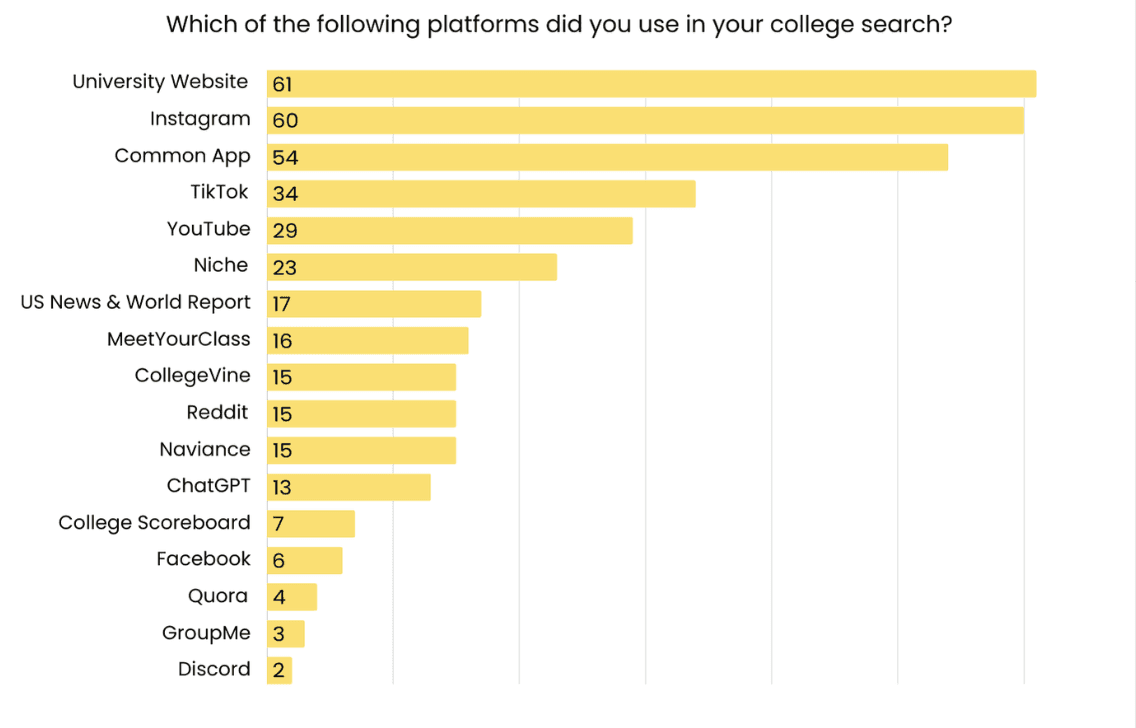
In the 2026 College Decision Playbook, we asked students which platforms they used during their college search. TikTok came in at 34 mentions, second among social platforms behind Instagram at 60, ahead of YouTube (29), and Reddit (15).
Pew's most recent teen survey, fielded in the fall of 2025, puts about 60 percent of teens on TikTok, with 61 percent of those users there daily and roughly one in five saying they're on it almost constantly.
The institutional footprint hasn't caught up. Across the 1,842 distinct four year institutions operating in the US (estimated):
Platform | Four year institutions with an account | Coverage |
|---|---|---|
1,717 | 93.2% | |
1,697 | 92.1% | |
TikTok | 723 | 39.3% |
Source: Reach by MeetYourClass, August 12, 2026
Instagram and Facebook are close to universal. TikTok sits under 40 percent, on the platform that ranks second in the college search.
The schools that are on TikTok are mostly active, with 75 percent posting in the last 30 days and a median of eight days since the last post. But 45 accounts haven't posted in over a year, and they're holding 544,139 followers between them. Virginia Tech's bio says it out loud: "The official TikTok for #VirginiaTech. (This account is currently inactive.)"
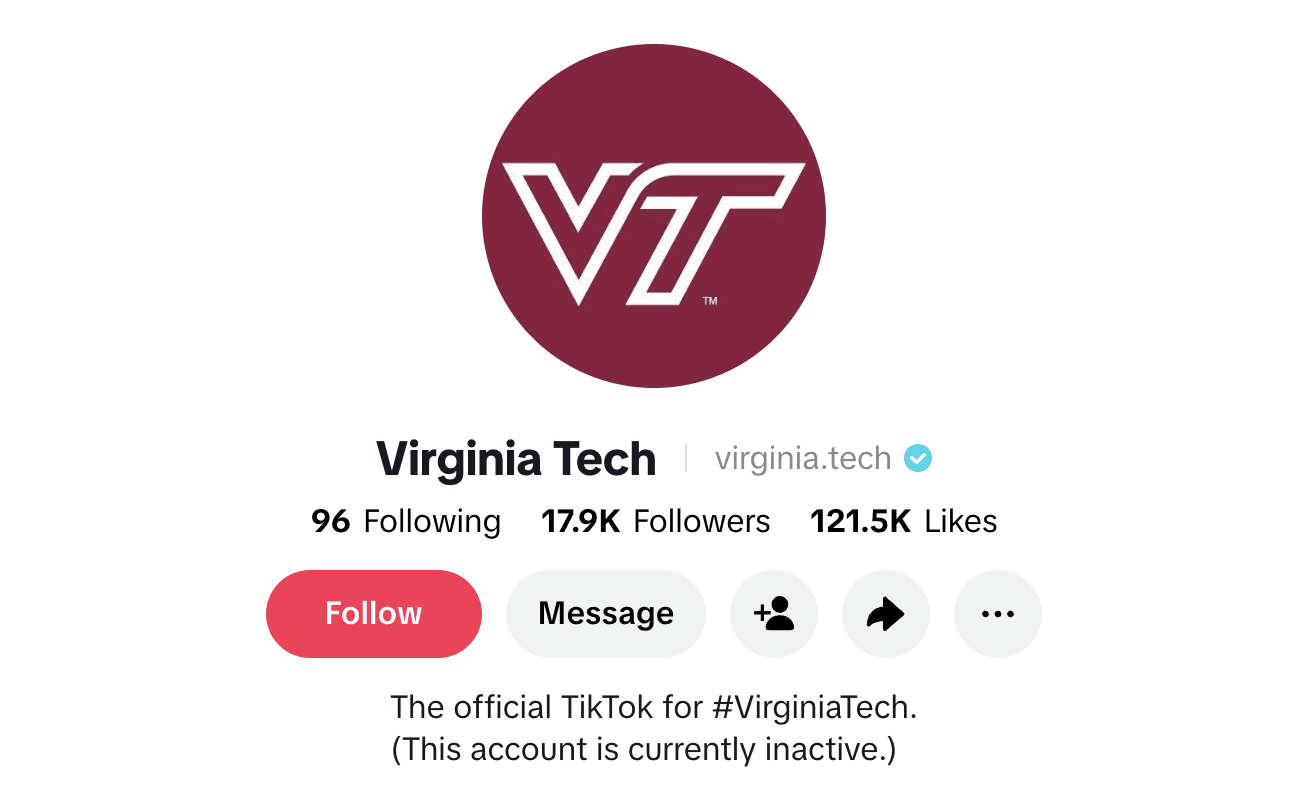
Those audiences didn't leave. In the last eight months alone, 36 of those 45 dormant accounts gained followers, and only one lost more than a percentage point. The median grew about 5 percent, and together they added 13,063 followers while publishing nothing at all, which we know because the post count on each account never moved. Virginia Tech went from 16,100 followers to 17,900 without a single new video. Florida Atlantic, silent since January 2023, grew 17 percent. Florida added 3,700 followers to an account that last posted on Christmas Eve 2022.
We only started tracking these counts in December 2025, so we can't tell you what happened in 2023 and 2024. But in the eight months we can see, students kept finding and following college accounts that have been dark since before they started high school.
What to expect
Nobody should expect their institution to flip this on next week. No state has rescinded. Texas reaffirmed and expanded its prohibited technology list in February, after the ownership deal had already closed. Florida legislators called it premature in January. Texas A&M's guidelines carry a May 2026 effective date, and UF's policy page was last updated in January and still bars affiliated accounts from posting.
The states that wrote universities into binding statute (Louisiana, Mississippi, Tennessee, Texas, Virginia, Florida) will be slowest, because undoing it takes a legislature or a board. There's also a suit pending in the D.C. Circuit arguing that ByteDance's continued ownership of the recommendation algorithm preserves a prohibited relationship.
But the direction is one way now, and there's real work to do before your turn comes.
Start by finding out what your policy actually says today rather than what you remember from 2023. A lot of institutions sit in the more permissive tiers above, where the restriction either stopped at state agencies or was written to allow posting from equipment the state doesn't own. You may have more room than you think. If your account has been dormant, confirm someone still has the credentials, because the handle is the asset. And when your CIO or general counsel gets asked about this, be the person who already has the one pager on what the DOJ opinion says, what the OMB memo does and doesn't do, what your state's order actually covers, and what Purdue did in July.
Then build the bank, because you can't ship a strategy the week a restriction lifts. For reference, Reach's benchmarks across 619 four year institutional accounts: 15,321 average followers, 3.03 percent average engagement, about four posts per 30 days. Across all institution types, average video length runs 34 seconds, and while Campus Life is the biggest content category at 28 percent of posts, Memes and Comedy carry the highest engagement rate at 4.04 percent on only 8.5 percent of volume. Video outperforms carousels.
Three years ago a lot of good social teams were told to stop working on the platform where their audience actually lives. Some found a way around it with a personal phone. The rest are about to get the chance back, and the ones with a handle, a plan and a full camera roll will be first.
Reach by MeetYourClass tracks 8,930 social accounts across 3,752 U.S. institutions. Figures computed August 12, 2026.
On the four year denominator, since raw IPEDS gives a different number: we start from the 1,948 institutions classified "degree granting, primarily baccalaureate or above," then remove 14 verified closed since the 2024 release, 5 merged or absorbed, 76 chain branch records that roll up to a parent holding the account, and 11 online or continuing education division records. That leaves 1,842. Accounts are deduplicated per platform. Coverage reflects handles Reach has collected and isn't proof an institution has no account.


