Article
Transitioning to Generation Alpha: Why This Cycle is Fundamentally Different
The higher education landscape is shifting beneath our feet, and it's not a minor adjustment. As we move through the 2026 enrollment cycle, we are seeing the early transition between Gen Z and Generation Alpha entering the college search process.
Unlike their Gen Z predecessors, this cohort—raised during a period of intense global and economic turbulence—is approaching their futures with a distinct set of priorities: risk reduction, financial pragmatism, and a need for control and planning.
The Generational Pivot: Why the Gen Z Playbook is Failing
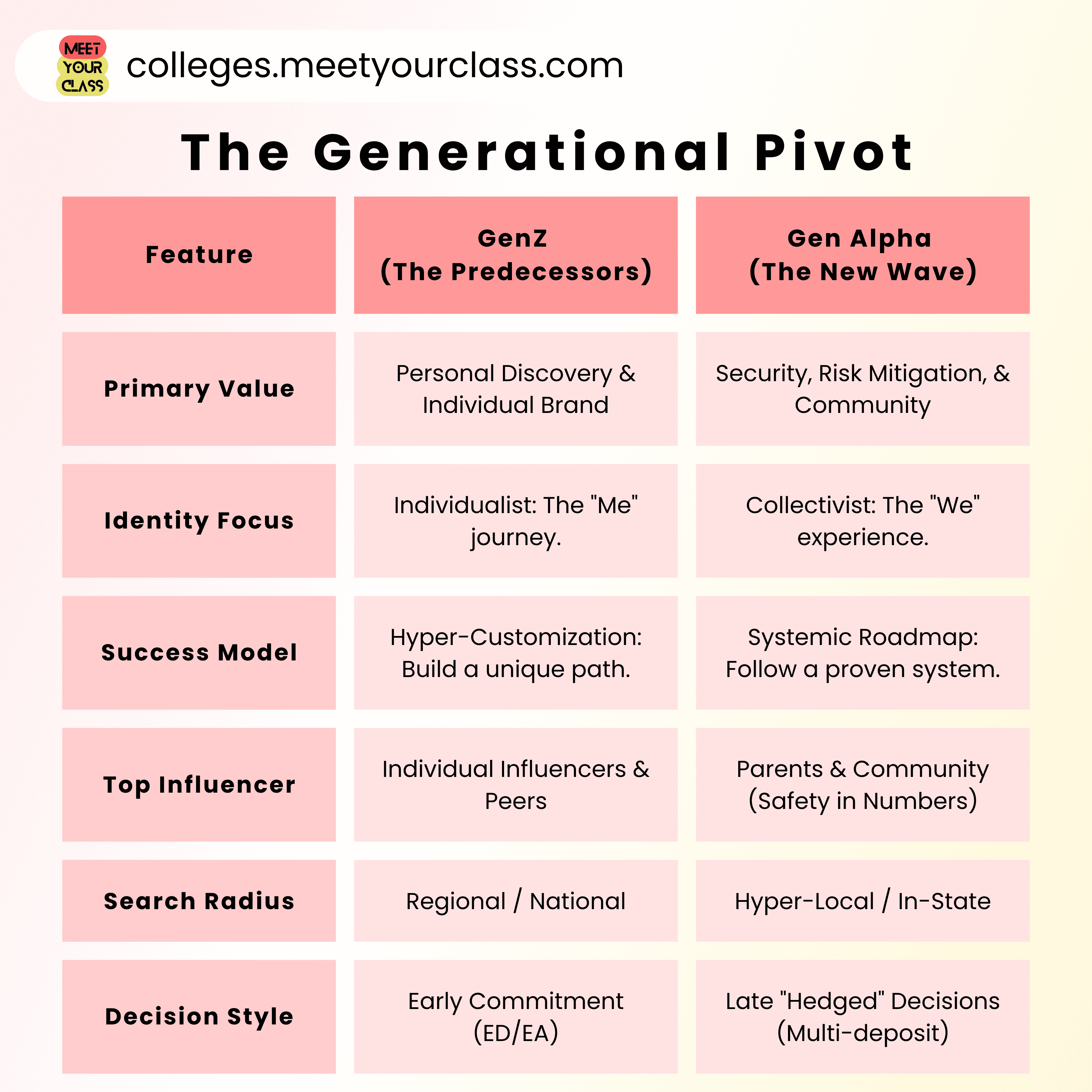
To understand why our traditional funnel metrics are lagging, we have to look at the fundamental shift in DNA between the outgoing Gen Z and the incoming Gen Alpha. This isn't just a trend; it's a structural change in how the next generation of students weigh risk and reward.
A Generation Defined by Turbulence and Risk Mitigation
Generation Alpha has matured in an era of volatility, which has fostered a heightened desire for stability and predictability. We see this reflected in three major behavioral shifts:
Pragmatic over Prestigious: For Gen Alpha, high selectivity is often viewed as an "unnecessary risk" rather than a badge of honor. In fact, 61% of students report that acceptance rates do not influence their likelihood to apply, with many actively preferring institutions where the path to admission feels certain.
Systems Over Customization: While Gen Z prioritized "building a bespoke brand," Gen Alpha views open-ended customization as a liability. They prefer a Systemic Roadmap—a proven, low-risk blueprint that others are successfully using to reach the goal. By following a pre-set system, they reduce the chance of making a "wrong" choice in an uncertain economy.
Outcome-Obsessed: This generation is scrutinizing institutional value through a lens of career readiness. Interest in retention rates as a decision factor nearly tripled year-over-year, surging from 20% to 58%.
Staying Closer to Home: The New Geographic Reality
There is a subtle but clear shift toward staying closer to home. According to the 2026 College Decision Playbook—a 3,500 student survey—students are increasingly narrowing their focus:
In-State Exclusivity: The share of students considering exclusively in-state colleges increased from 36% to 41%.
Out-of-State Decline: Those looking exclusively out-of-state dropped by half, falling from 10% to 5%.
Community College Surge: Interest in community colleges rose from 24% to 31%, reflecting a growing awareness of affordable pathways and the flexibility of living at home.
This trend is further supported by broader demographic shifts; for example, a 2023 EAB report highlighted that nearly 75% of students now attend college within 250 miles of home to manage costs and maintain familial support networks.
The Rise of the "Co-Decision" Era: Parental Influence
Gen Alpha grew up under constant parent supervision, both online and in person. This "velcro" parenting style has solidified parents as the ultimate influencers in the decision process:
Parents as Top Influencers: Nearly 90% of students indicate their parents played a meaningful role in their enrollment decision.
Increasing Impact: Parental influence grew from 70% to 75% in the latest survey, suggesting they are the "most powerful human influence" in the journey.
The Strategy of Control: Double Depositing and Late Decisions
To regain a sense of control over an unpredictable process, Gen Alpha is delaying their final "yes."
The Double Deposit Trend: A striking 20% of respondents submitted enrollment deposits at more than one college. This isn't just indecision; it’s a strategy to "hedge their bets" while they continue to compare financial aid offers (cited by 64% of multi-depositors) and evaluate campus culture fit late into the spring.
"Silent" Engagement: Anecdotally and through conversations with enrollment leaders across the country and analysis from our consulting team, we see students visiting campus later and lower attendance at early in-person events. This aligns with a generation that conducts "social audits" online first, only showing up in person once they have narrowed their list down to the final few.
Adjusting Our Expectations
To reach Gen Alpha, universities must stop treating community as the result of enrollment and start viewing it as the primary driver.
The "We" Focus: Finding belonging is critical to reducing uncertainty. Ninety-two percent of students stated they are more likely to enroll where the sense of community is strong.
Indicators are Shifting: Traditional milestones like "early tours" are becoming less predictive. Look at digital community engagement—joining "Class of" pages or peer-to-peer platforms—as the new "high-intent" signal.
Social Commitment Data: Students that indicate their university commitment status on MeetYourClass enroll 94% of the time, a metric more accurate than traditional deposits.
Target the Parents: Since parents are the primary advisors on cost and safety, your marketing must provide them with the transparency and financial certainty they need to feel the investment is "low risk."
The 2026 cycle proves that Gen Alpha won’t follow the old playbook. They are writing a new one centered on transparency, proximity, and peer-to-peer validation.


